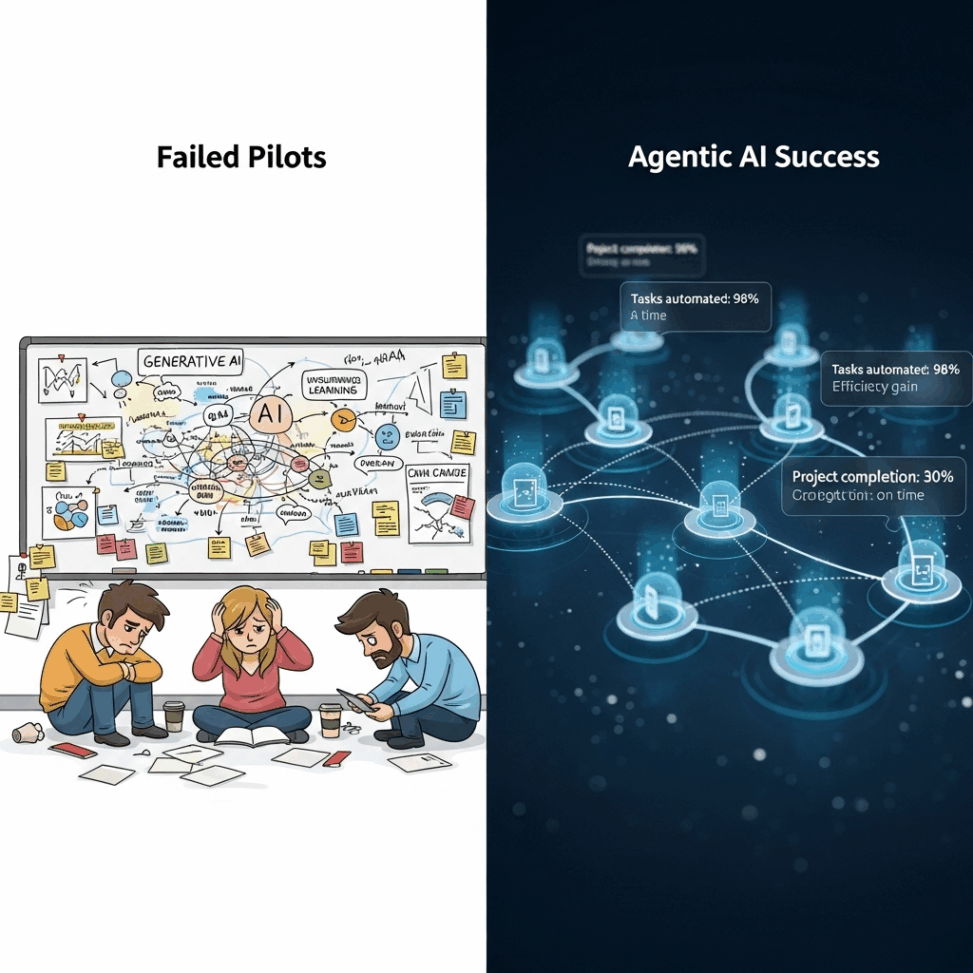
The Harsh Reality: Why Generative AI Pilots Often Miss the Mark
Generative AI has captivated the world with its incredible capabilities, from creating stunning art to writing compelling text. Yet, beneath the dazzling surface, a sobering truth emerges: a striking 95% of generative AI pilots fail to show measurable business impact. This isn’t just a minor setback; it’s a wake-up call for organizations investing heavily in AI initiatives.
So, why are so many promising ventures falling short of delivering tangible value?
The Generative AI Paradox: Promise vs. Performance
The challenges often stem from a few critical areas:
- Focusing on ‘Cool’ Over ‘Critical’: Many pilots prioritize showcasing impressive generative outputs rather than solving specific, high-value business problems with clear key performance indicators (KPIs).
- Lack of Defined ROI: Without a clear understanding of the return on investment from the outset, it’s difficult to measure success beyond initial wow factor.
- Integration Headaches: Tying generative AI models into existing complex enterprise systems, ensuring data quality, and maintaining security can be far more challenging than anticipated.
- Scalability and Reliability: Moving from a proof-of-concept to a robust, enterprise-grade solution often reveals issues with consistency, control, and performance at scale.
- Guardrails and Ethical Concerns: Ensuring responsible and safe use of generative outputs, especially in customer-facing applications, requires significant effort in design and oversight.
Enter Agentic AI: The Evolution of Intelligent Systems
The solution to these challenges may lie in the next evolution of AI: Agentic AI. While generative AI excels at creating, agentic AI takes a critical leap forward, focusing on autonomous action and goal achievement. It’s a paradigm shift that demands a fundamentally new approach to how AI products are designed and deployed.
What Exactly is Agentic AI?
Unlike generative models that primarily focus on producing content based on prompts, agentic AI systems are designed to:
- Operate Autonomously: They can make decisions and take actions without constant human intervention.
- Pursue Specific Goals: Rather than just responding to prompts, agents are given high-level objectives and work to achieve them.
- Engage in Sequential Decision-Making: They can plan, execute steps, monitor progress, and adapt their strategy over time.
- Interact with Environments: Agents can perceive their surroundings (digital or physical), process information, and act upon it to achieve their goals.
- Solve Complex Problems: They can break down large, intricate tasks into smaller, manageable sub-tasks and execute them iteratively.
Think of it this way: if generative AI is a brilliant artist, Agentic AI is an intelligent project manager that plans, delegates, executes, and monitors progress to deliver a finished product.
The ‘Agentic Shift’ in Product Design: A New Blueprint for Success
To harness the power of agentic AI, organizations must rethink their product design philosophy. This isn’t just about tweaking existing processes; it’s about a holistic re-evaluation:
1. Goal-First Design, Not Output-First
Instead of asking, ‘What can this AI generate?’, the question becomes, ‘What business problem can this AI agent autonomously solve, and what measurable impact will it have?’ Design starts with defining clear, quantifiable objectives for the agent.
2. System-Level Thinking
Agentic AI requires designing entire workflows and ecosystems where agents collaborate, interact with existing systems, and navigate real-world constraints. This moves beyond individual model integration to comprehensive system architecture.
3. Robustness, Resilience, and Error Handling
Autonomous agents must be designed to anticipate and handle unexpected situations, learn from failures, and operate reliably. This includes sophisticated error detection, recovery mechanisms, and clear human-in-the-loop protocols for oversight.
4. Human-Agent Collaboration
The future isn’t about AI replacing humans entirely, but about intelligent collaboration. Product design must focus on intuitive interfaces that allow humans to set goals, monitor agent performance, provide feedback, and intervene when necessary, fostering trust and efficiency.
5. Ethical AI by Design
With greater autonomy comes greater responsibility. Designing agentic systems requires proactive consideration of ethical implications, fairness, transparency, and safety mechanisms from the very beginning of the development cycle.
From Pilots to Profits: Unlocking Real Business Value
By embracing an agentic approach, companies can move beyond the ‘pilot purgatory’ and unlock significant, measurable business impact. Agentic AI can drive value by:
- Automating Complex Workflows: Taking on multi-step tasks that traditionally required significant human effort or fragmented systems.
- Optimizing Operations: Continuously analyzing data and adjusting processes in real-time for improved efficiency and cost savings.
- Delivering Hyper-Personalization: Creating dynamic, tailored experiences for customers based on their evolving needs and behaviors.
- Accelerating Innovation: Automating research, development, and testing cycles to bring new products and services to market faster.
The staggering 95% failure rate of generative AI pilots isn’t a sign of AI’s limitations, but rather a reflection of misaligned expectations and outdated design methodologies. Agentic AI offers a compelling path forward, promising not just innovation, but demonstrable and sustainable business transformation. Organizations that adapt their product design philosophy now will be best positioned to thrive in this exciting new era of autonomous intelligence.
Leave a Reply