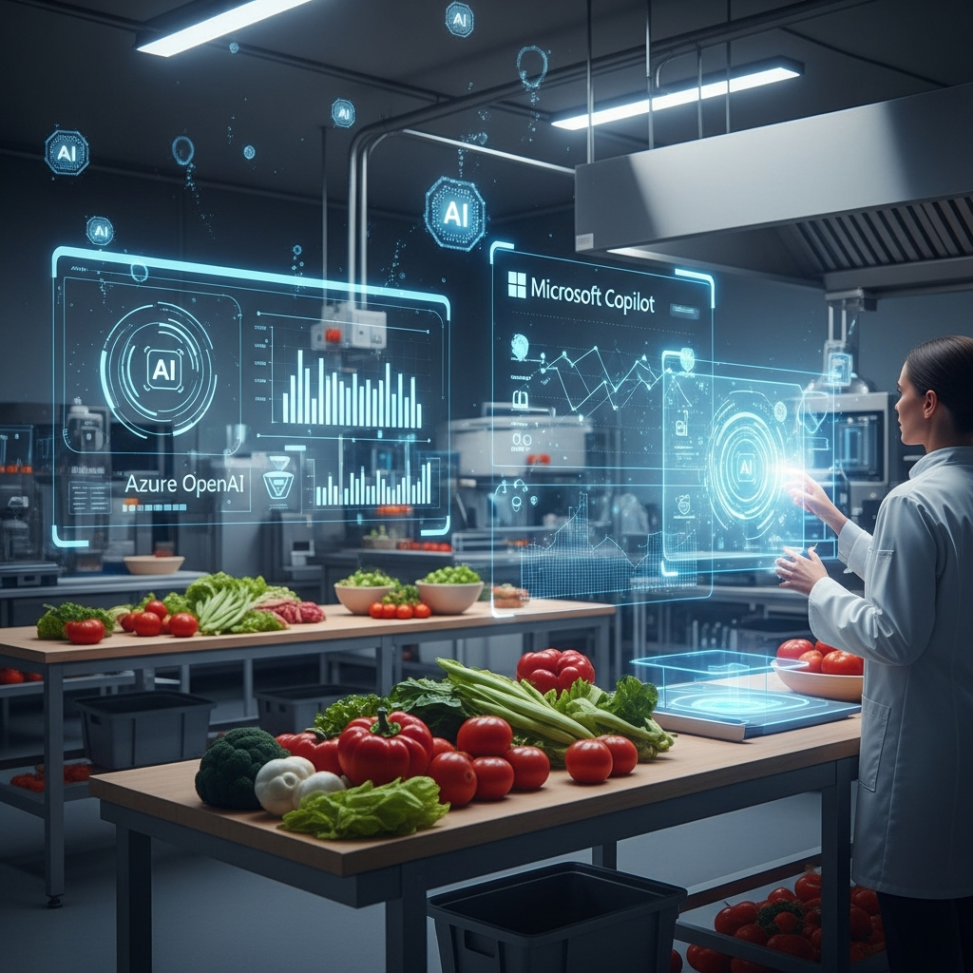
The AI Revolution in Food Tech: How Microsoft Copilot & Azure OpenAI Are Driving Innovation
The food industry, ever-evolving and increasingly complex, faces constant pressure to innovate, reduce waste, and operate with maximum efficiency. From farm to fork, every step presents challenges – and opportunities. This is where Artificial Intelligence (AI) steps in as a transformative force, with powerhouses like Microsoft Copilot and Azure OpenAI leading the charge to redefine what’s possible in food technology.
These advanced AI tools are not just buzzwords; they are practical solutions that enable businesses to automate repetitive, time-consuming tasks. By offloading these operational burdens, food companies can redirect their focus and resources towards strategic initiatives, innovation, and ultimately, delivering better products and experiences.
What Are Microsoft Copilot and Azure OpenAI?
Before diving into their impact, let’s briefly understand these pivotal technologies:
- Microsoft Copilot: Think of Copilot as your AI-powered assistant for productivity. Integrated across Microsoft 365 applications, it leverages large language models (LLMs) to help users with everything from drafting emails and summarizing documents to generating presentations and analyzing data. For the food industry, this means streamlining administrative tasks, report generation, and internal communications.
- Azure OpenAI Service: This service provides businesses with secure access to OpenAI’s powerful language models, including GPT-4, DALL-E, and more, directly through Microsoft Azure’s enterprise-grade infrastructure. It allows companies to build custom AI applications with advanced capabilities like natural language processing, code generation, and image generation, all while benefiting from Azure’s security and compliance features.
Transforming Food Tech: Beyond Basic Automation
The synergy between Microsoft Copilot and Azure OpenAI creates a fertile ground for innovation across the food sector:
1. Precision Demand Forecasting & Waste Reduction
One of the most significant challenges in the food industry is accurately predicting demand to minimize waste and ensure freshness. AI models, powered by Azure OpenAI, can analyze vast datasets—including historical sales, seasonal trends, weather patterns, social media sentiment, and even local events—to generate highly accurate demand forecasts. This precision allows businesses to:
- Optimize inventory levels, reducing spoilage and overstocking.
- Streamline production schedules, saving energy and labor costs.
- Improve supply chain logistics, ensuring timely delivery of fresh ingredients.
2. Streamlined Content Creation & Marketing
From captivating product descriptions to engaging marketing campaigns, content is crucial. Microsoft Copilot can assist marketing teams in:
- Drafting compelling ad copy and social media posts for new food products.
- Generating internal training materials and standard operating procedures (SOPs).
- Personalizing customer communications and recipe suggestions.
Leveraging Azure OpenAI, companies can even automate the creation of entire campaign strategies, analyze market trends to suggest new product concepts, or generate unique visual content for branding.
3. Enhanced R&D and Product Innovation
The quest for new flavors, healthier options, and sustainable products is continuous. AI can dramatically accelerate this process:
- Ingredient Pairing: AI can analyze ingredient properties and consumer preferences to suggest novel combinations and formulations.
- Recipe Development: Generate new recipe variations based on nutritional profiles, dietary restrictions, or specific flavor profiles.
- Market Trend Analysis: Identify emerging food trends and consumer preferences to guide product development before competitors.
4. Optimized Supply Chain and Operations
From sourcing to distribution, the food supply chain is intricate. AI can bring unprecedented clarity and efficiency:
- Predictive Maintenance: Monitor equipment in processing plants to predict failures, minimizing downtime.
- Route Optimization: Enhance delivery logistics for freshness and fuel efficiency.
- Quality Control: AI-powered vision systems can inspect produce or products for defects faster and more consistently than human eyes.
5. Personalized Consumer Experiences
Consumers increasingly expect tailored experiences. AI allows food businesses to:
- Offer personalized meal plans and recipe recommendations based on individual dietary needs, preferences, and health goals.
- Provide instant, AI-driven customer support for queries about products, ingredients, or allergens.
The Strategic Edge: Focusing on What Matters
By automating these foundational and often labor-intensive tasks, food tech companies are liberated to focus on higher-value activities. This strategic shift enables them to:
- Accelerate Innovation: Dedicate resources to breakthrough research and development.
- Improve Sustainability: Make data-driven decisions that reduce environmental impact and waste.
- Enhance Customer Loyalty: Deliver personalized and consistent experiences.
- Achieve Cost Savings: Optimize operations, reduce waste, and streamline workflows.
Looking Ahead: A Flavorful Future with AI
The integration of Microsoft Copilot and Azure OpenAI into the food tech landscape is more than just a technological upgrade; it’s a paradigm shift. It empowers businesses to operate smarter, innovate faster, and serve consumers better. As AI continues to evolve, its role in creating a more efficient, sustainable, and delicious food future will only grow, cementing its status as an indispensable partner for the industry’s heroes.
Leave a Reply