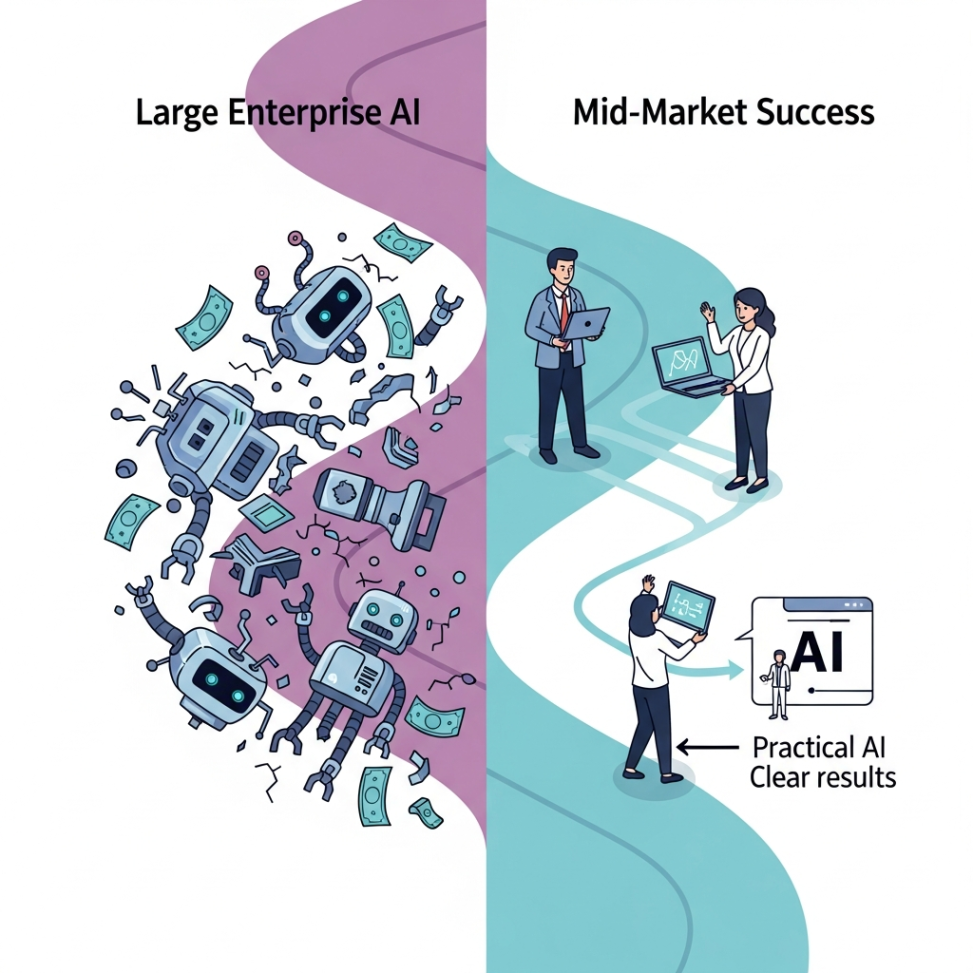
The AI Revolution: A Double-Edged Sword for Businesses
Artificial Intelligence (AI) is undoubtedly transforming the business landscape, promising unprecedented efficiencies, insights, and growth. Yet, for every success story, there are cautionary tales. Many F100 companies, despite colossal budgets, have found themselves mired in costly AI projects with limited returns. This presents a unique opportunity for mid-market companies: learn from their missteps and carve a more effective path.
If you’re a mid-market leader feeling the pressure to adopt AI but wary of the hype and potential for waste, this playbook is for you. We’ll explore why big players often stumble and how your agility can turn into a significant advantage.
Why F100 Companies Often Miss the Mark with AI
While large enterprises have vast resources, they also face specific challenges that can derail AI initiatives:
- Chasing the ‘Perfect’ AI: A tendency to wait for advanced, general AI solutions or to over-engineer complex systems rather than starting with practical applications.
- Over-investment in ‘Moonshot’ Projects: Allocating billions to grand, speculative AI endeavors with vague business objectives and unclear ROI.
- Ignoring Foundational Data: Attempting to build sophisticated AI models on messy, siloed, or incomplete data, leading to skewed results and wasted effort.
- Lack of Clear Business Objectives: Implementing AI because it’s ‘the next big thing’ rather than identifying specific problems it can solve.
- Getting Bogged Down in Complexity: Large organizational structures and legacy systems can make agile AI deployment difficult, leading to long development cycles and spiraling costs.
The lesson here isn’t that AI is flawed, but that its implementation strategy is critical. And this is where mid-market companies can truly shine.
The Mid-Market Advantage: Agility, Focus, and Practicality
Mid-market businesses possess inherent advantages that position them for more effective AI adoption:
- Agility and Quicker Decision-Making: Leaner structures allow for faster adoption and iteration of AI solutions.
- Closer to Core Problems: You often have a clearer understanding of immediate operational pain points and customer needs, making it easier to identify high-impact AI use cases.
- Focus on Tangible ROI: Without the pressure of competing on ‘bleeding-edge’ AI, mid-market companies can prioritize solutions that deliver measurable value quickly.
Your Mid-Market AI Playbook: Avoiding the F100 Mistakes
Here’s how mid-market companies can navigate the AI landscape successfully:
1. Ignore the Hype, Embrace Pragmatism
Don’t get sidetracked by buzzwords or futuristic visions. Instead, focus on specific, solvable business problems that AI can address today. The goal isn’t to have the most advanced AI, but the most effective AI for *your* business needs.
2. Start Small, Scale Smart
Identify low-hanging fruit. Think about repetitive tasks or data analysis challenges that, even with a small AI intervention, could yield significant efficiency gains or cost savings. Implement proof-of-concept projects, learn from them, and then scale successful initiatives strategically across your organization.
3. Prioritize Data Readiness
AI is only as good as the data it’s trained on. Before diving into complex models, invest time in cleaning, organizing, and integrating your existing data. A solid data foundation is crucial for any successful AI endeavor.
4. Leverage Off-the-Shelf and Low-Code Solutions
You don’t always need to build bespoke AI from scratch. Many excellent Software-as-a-Service (SaaS) AI tools exist for common applications like customer service, marketing automation, and data analytics. Furthermore, low-code/no-code AI platforms can empower business users to create custom solutions without extensive programming knowledge, accelerating deployment and reducing costs.
5. Focus on Business Value, Not Just Technology
Every AI project should start with a clear definition of the business problem it intends to solve and a measurable objective. Will it reduce operational costs by X%? Improve customer satisfaction by Y points? Increase sales conversions by Z%? Tie your AI initiatives directly to your strategic business goals.
6. Build Internal Capabilities (or Partner Wisely)
Invest in upskilling your existing team members, equipping them with the knowledge to understand and manage AI tools. For more complex needs, consider strategic partnerships with AI consultants or vendors who can provide specialized expertise without the overhead of building a large internal AI team.
The Future is Agile: Winning with Smart AI
The promise of AI is real, but its realization doesn’t depend on endless budgets. For mid-market companies, success lies in a pragmatic, focused, and agile approach. By learning from the missteps of the F100, ignoring the hype, and prioritizing tangible business value, you can implement AI effectively and position your company for sustainable growth in the AI-driven future.
Leave a Reply